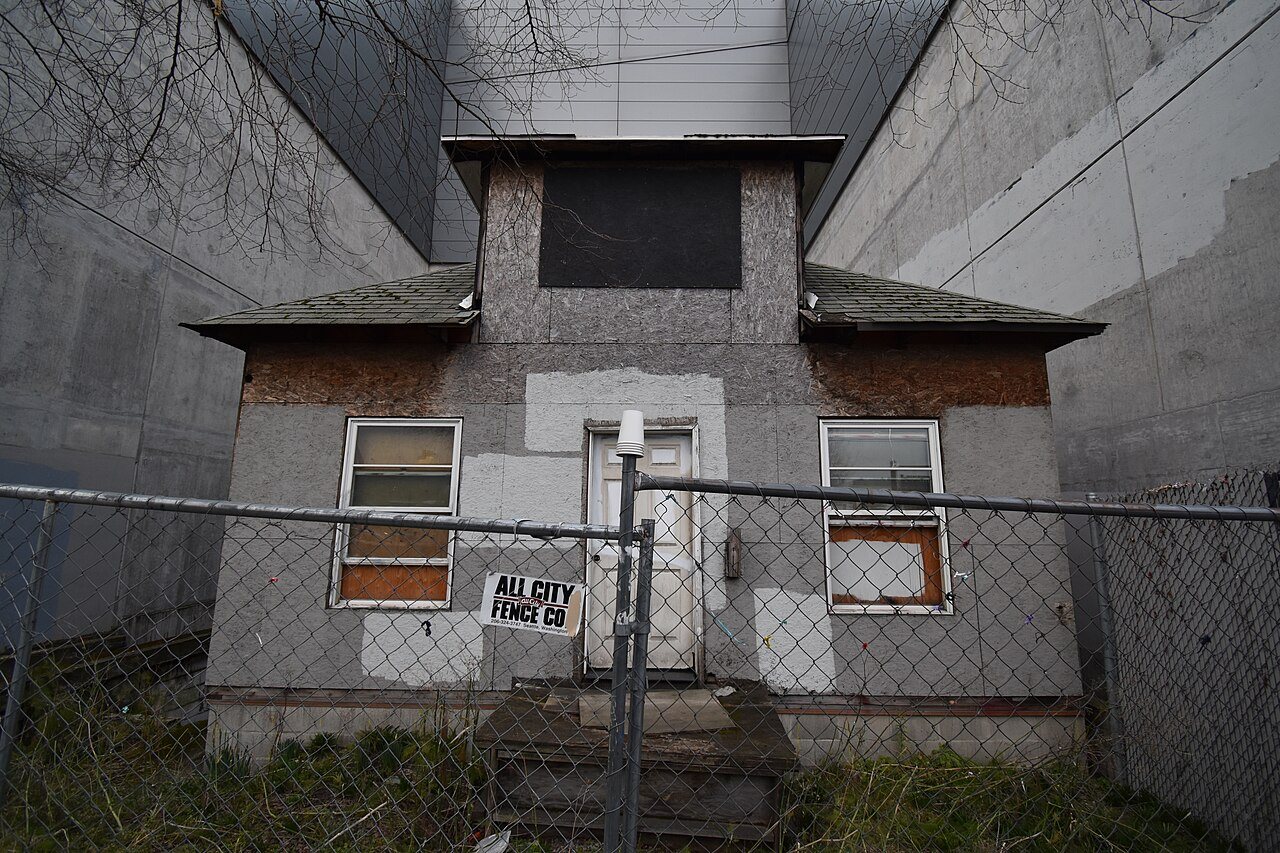
Photo: Fred Cherrygarden, CC BY-SA 4.0, via Wikimedia Commons
On NW 46th Street in Seattle's Ballard neighborhood there is a small, boxy old farmhouse that looks as if someone forgot to move it. On three sides, the concrete walls of a five-story commercial building rise straight up around it, close enough that the house sits in a kind of well. It has been boarded up for years and wears a chain-link fence like a cast.
It belonged to Edith Macefield. In 2006, when developers were assembling the block for a new shopping and office complex, they offered her a package reported at first as worth $750,000 and later at around $1 million to sell up and leave. She was in her eighties, and the house was old and modest. She said no.
So they built around her. The story has been told many times since, usually with the wrong ending attached, and the real one is stranger and kinder than the myth.
The house and the woman in it
Macefield was born Doris Edith Wilson in North Bend, Oregon, in 1921. By the time the developers came calling she had lived in the Ballard house for decades. Her mother had died there in 1976, on the same couch where Edith would later spend her own last days, and by most accounts she simply did not want to leave the place.
When the house came up in 2006 it was described in news reports as a roughly 108-year-old farmhouse, which puts its construction at around the end of the nineteenth century. It was the sort of small working family house that once filled Ballard, a neighborhood with deep Scandinavian and fishing roots that was being rebuilt fast in the 2000s.
Macefield never made a big public speech about why she refused. From the accounts that came out later, she just did not want to move, and she was not much interested in what anyone else thought she ought to do. I find that oddly refreshing.
Building a shopping center around one stubborn house
The developers went ahead anyway. The commercial building was designed and built so that it wrapped around Macefield's lot on three sides, leaving her house where it had always stood. For months she lived in the middle of a construction site, with the work going on a few feet from her walls.
This is where the story turns. The construction superintendent on the project began checking in on her. He drove her to appointments, picked up her groceries and helped her as her health declined. Over time the two became genuine friends. When Macefield died of cancer at home in June 2008, aged 86, she left the house to him in her will.
It is hard to think of a better rebuttal to the idea that holdouts are simply cranks. She kept her home, and the man sent to build around it ended up looking after her.
The Up connection, and why it is mostly a myth
Almost every retelling now calls this the real "Up house," after the 2009 Pixar film about an old man who refuses to let developers take his home and floats it away with balloons. The resemblance is obvious, and in May 2009 Disney publicists leaned into it by tying a bunch of balloons to Macefield's roof to promote the film's release. (Much of the effect was spoiled when the wind pushed the balloons into the surrounding walls and popped them.)
But the film was not based on her. Work on the Up script began in 2004, two years before Macefield ever turned down an offer. The two stories arrived independently and the public simply fused them, which is probably the most Seattle thing about the whole affair.
What happened to the house
The heir sold the house in 2009 for $310,000 to a real estate investor who planned to use it as an office for his business. That plan never really worked out. By 2015 the property was headed to a foreclosure auction over unpaid taxes, and various rescue ideas came and went without much result.
Since then it has mostly sat empty. A more recent listing offered it for lease as commercial space, and photos from early 2025 show it boarded and fenced, its walls patched, still wedged into its concrete pocket. Fans have left small tributes on the fence over the years, and Ballard even held a Macefield Music Festival in her name starting in 2013.
If a developer ever knocks on your door
Most of us will never be offered a million dollars for a bungalow, but buyouts from developers assembling a site are more common than people think, especially in fast-growing neighborhoods. A few general points are worth knowing.
A private developer generally cannot force you to sell. Eminent domain, the power to take property for public use with compensation, belongs to governments. After the Supreme Court's 2005 Kelo v. City of New London decision allowed a city to take homes for an economic development plan, many states passed laws limiting that power, so the rules depend a great deal on where you live.
If an offer arrives, get your own independent appraisal instead of relying on the buyer's figure, and talk to a real estate attorney before signing anything, including a letter of intent. Ask about timing, moving costs and whether you can stay on as a renter for a while, which developers sometimes agree to.
And if you just want to stay, you are allowed to say no. Edith Macefield did, and the shopping center learned to live with it.
This article is general information, not legal advice.