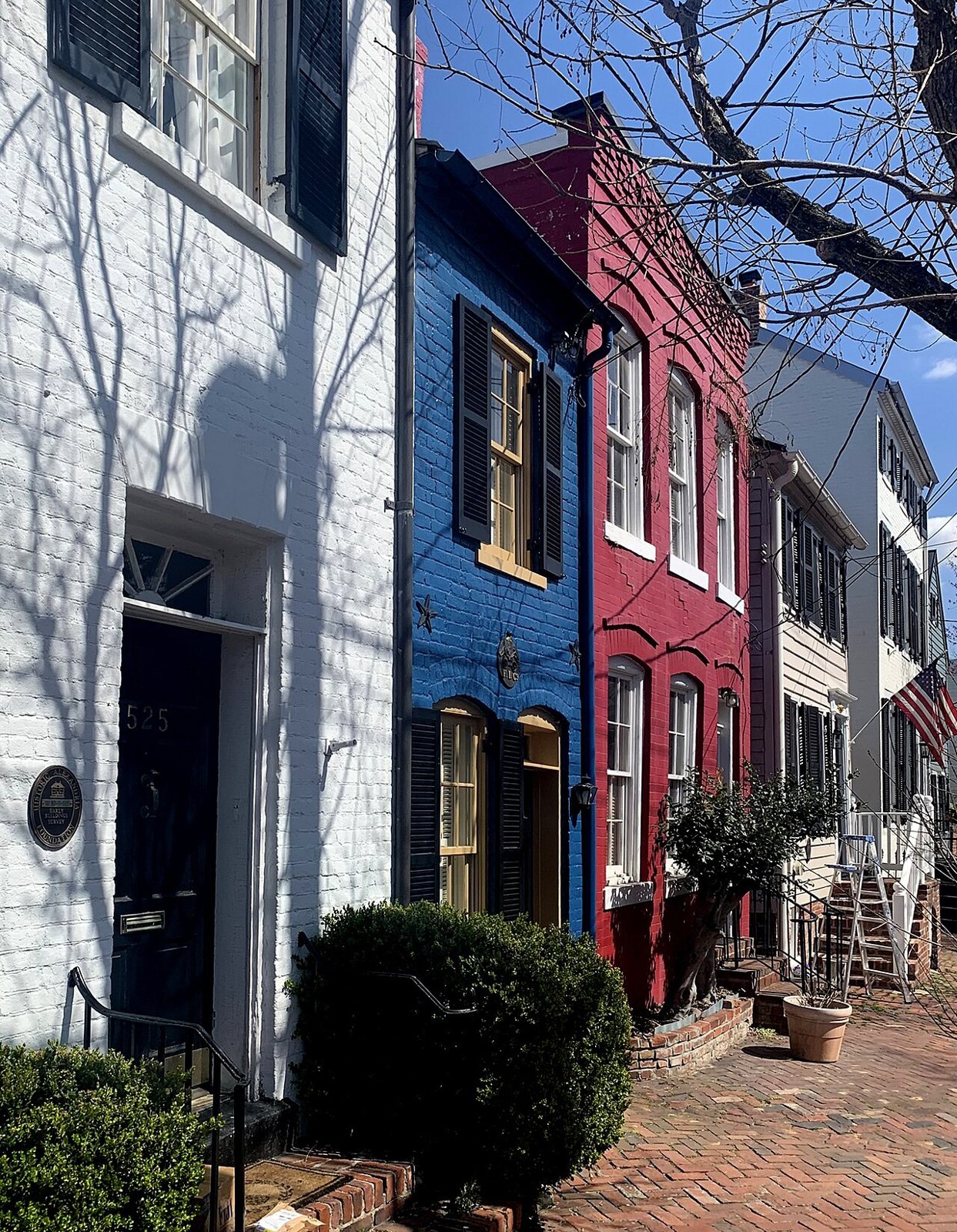
On Queen Street in Old Town Alexandria, Virginia, there is a blue brick house so narrow that it looks as if someone forgot to finish the job. It is about seven feet wide. The front door and one window take up most of the façade, and the side walls belong, more or less, to the buildings on either side.
It is known locally as the Hollensbury Spite House, and the name tells you most of the story. In 1830 John Hollensbury, who owned the house next door, enclosed the alley beside his home, roofed it over and turned it into a dwelling. The version told in Alexandria is that he was fed up with horse-drawn wagons and loiterers using the alley, and building a house in it was the most permanent fix available.
Spite houses turn up wherever people live close together and someone holds a grudge. Some are real, some are mostly legend, and a few have changed the law. I have a soft spot for them, partly because they are such a strange use of time and money, and partly because almost all of them ended up as perfectly good homes.
What makes a house a spite house
The term is loose. In general it means a building put up, or altered, mainly to irritate a neighbor or a community: to block light or a view, to stop access, or to sink someone's plans for a piece of land. The house itself is often an afterthought. Many are oddly shaped, because they were built on whatever leftover sliver of land the owner had to work with.
What they have in common is that the motive is the selling point. Nobody would remember the Hollensbury house if it had been built by someone who simply needed a small place to live.
Boston's Skinny House and its disputed legend
Boston's best-known example is at 44 Hull Street in the North End, across from Copp's Hill Burying Ground. It is a four-storey house that tapers to around ten feet at its widest, and it is usually called the Skinny House or the Spite House.
The story most often told is about two brothers who inherited land from their father. One went off to serve in the Civil War, and when he came back he found his brother had built a large house that took up most of the plot. So he built a narrow one on what remained, close enough to block his brother's light and view.
Historians haven't been able to confirm that version, and some accounts tell it differently. I'd treat it as folklore attached to an unusual building rather than documented fact. It remains a private home, and passing tourists photograph it constantly, which its owners must find either charming or exhausting.
The Manhattan house that was five feet wide
New York had the most extreme case. In 1882 Joseph Richardson, who owned a long, thin strip of land on Lexington Avenue at 82nd Street, built a narrow apartment building on it. The lot ran about a hundred feet along Lexington Avenue and was only about five feet deep.
According to the accounts reported at the time and repeated since, the owner of the neighboring lot, Hyman Sarner, had wanted to buy the strip so his own building could have windows facing the avenue. The two men could not agree on a price. Richardson built on it instead, blocking the view entirely. Papers called it the Spite House, and Richardson lived there until he died in 1897. The building was demolished in 1915.
When spite turned into law
Spite structures were common enough that several US states wrote rules about them. They mostly target fences rather than houses, because a tall fence is the cheaper way to make a point.
California's Civil Code treats a fence or similar structure over ten feet high, built maliciously to annoy a neighbor, as a private nuisance. Massachusetts has a similar statute for fences over six feet put up for the same purpose. Courts in other states have reached comparable results through nuisance law. The details vary a lot, and proving malice is usually the hard part, so these rules come up less often than you might think.
Living in one today
The funny thing about spite houses is how often they outlive the spite. The Alexandria house has been a home for close to two centuries and has been carefully kept up. The Boston house has been bought and sold as a residence. Even the New York building, cramped as it was, had tenants. Tiny, odd-shaped houses tend to attract buyers who like a story, and these come with one built in.
If you are dealing with a neighbor dispute yourself, the spite houses suggest a lesson, even if it isn't the one their builders intended. Before you spend real money on a grudge, talk to the neighbor, check your local zoning and fence rules, and look into community mediation, which many cities and counties offer. If it gets serious, a local real estate attorney can tell you what applies where you live. This is general information rather than legal advice, and the rules really do change from town to town.
And if you are ever in Old Town Alexandria, the blue house on Queen Street is worth a walk past. Admire it from the sidewalk. Somebody lives there.
See more of us on GoogleAdd Home Knowledge as a preferred source and our stories can show up more often for you in Top Stories.