Photo: Sil10napel, CC BY-SA 4.0, via Wikimedia Commons
The first cold week of the season is when you find out which radiators are pulling their weight. Run your hand up the front of each one once the heating has been on for a while. If a radiator is warm at the bottom and cool across the top, you almost certainly have air trapped inside.
Air collects at the highest point of a hot water heating system, and the top of a radiator is one of those high points. Hot water can't fill the space the air is taking up, so part of the radiator stays cold and the room never quite warms up. Letting that air out is called bleeding the radiator.
It is one of the easiest heating jobs there is. You need a radiator key (a small metal key that costs very little at any hardware store), an old towel or rag, and ten minutes or so.
First, check that air is the problem
Bleeding fixes one specific symptom: cold at the top, warm below. Other patterns point somewhere else.
If a radiator is cold at the bottom and warm at the top, the usual cause is sludge, a buildup of rust and debris settling in the bottom of the radiator. Bleeding won't help with that; the system may need flushing, which is a bigger job and often one for a heating engineer.
If a radiator is completely cold while others are hot, check that its valves are open before you do anything else. I have spent longer than I'd like to admit on a "broken" radiator whose valve was simply turned off.
One more distinction matters. Everything here applies to hot water radiators. Older steam radiators, still common in some older apartment buildings, have their own automatic air vents and work differently, so don't go looking for a bleed key for those.
What you need
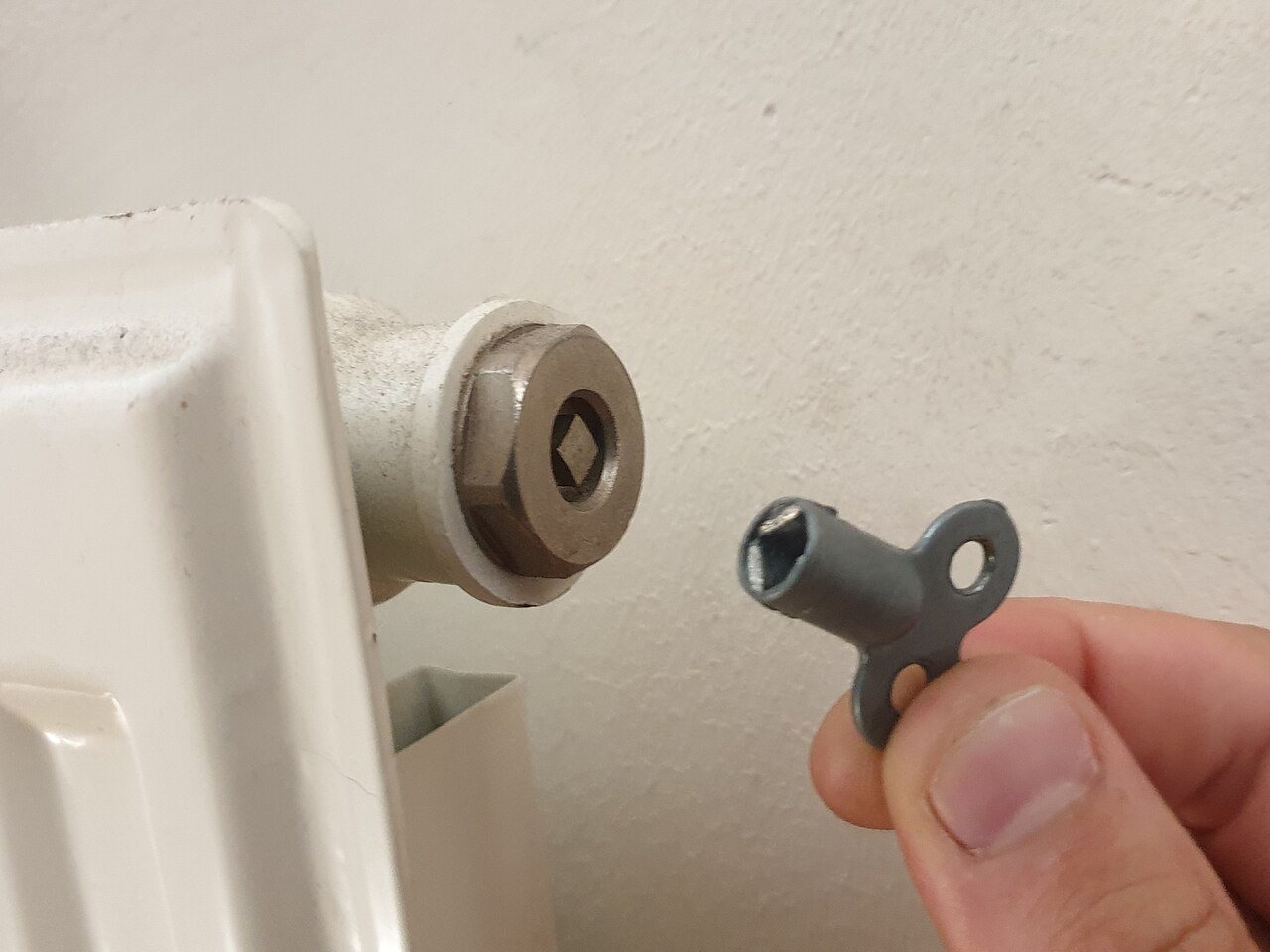
A radiator key that fits your valve. Most bleed valves take a small square key like the one in the photo. Some newer ones have a slot you can turn with a flat screwdriver.
A thick towel or rag to hold under the valve and catch drips.
A small container if you'd like a bit more protection for the floor.
How to bleed it, step by step
Turn the heating off and let the radiators cool down. The water inside can be very hot, and if the system's pump is running while you bleed, it can draw more air in.
Find the bleed valve. It is a small fitting at one of the top corners of the radiator, usually on the opposite side from the pipes.
Hold the towel under the valve and fit the key.
Turn the key slowly counterclockwise, about a quarter to half a turn. You should hear air hissing out. Do not open it all the way; you only need it cracked open.
Wait until the hissing stops and water starts to come out in a steady trickle rather than spits and bubbles. Then turn the key clockwise to close the valve. Snug is enough, don't force it.
Wipe up any water and move on to the next radiator that needs it.
Many plumbers suggest starting with the radiators on the lowest floor and working your way up, since air tends to rise through the system. It's not a strict rule, but it doesn't hurt to follow it.
Check the boiler pressure afterward
This is the step people forget. In a sealed system, which includes most modern combi boilers, letting out air also lowers the pressure. If it drops too far, the boiler may not fire properly or may lock out.
Look at the pressure gauge on the front of the boiler or near it. Your boiler's manual will give the right range; for many domestic systems it's somewhere around 1 to 1.5 bar when the system is cold. If it has dropped below that, the manual will explain how to top it up using the filling loop. If you're not comfortable doing that, it's a quick job for a heating engineer.
Older open-vented systems with a header tank in the loft top themselves up, so there's usually nothing to adjust.
When bleeding keeps coming back
Bleeding a radiator once or twice a year is normal. Needing to bleed the same radiator every week or two is not. Air getting into the system that often can point to a small leak, a fault with the pump or pressure vessel, or corrosion inside the system. That's the point to stop topping things up yourself and have someone qualified take a look.
For most homes, though, a ten-minute bleed in November is all it takes. Turn the heating back on afterward, give it half an hour, and run your hand up the front of the radiator again. It should be warm all the way to the top.
See more of us on GoogleAdd Home Knowledge as a preferred source and our stories can show up more often for you in Top Stories.