Rugs are usually bought one size too small. I say that with sympathy, because it is an easy mistake. The bigger rug costs more, the smaller one looks generous rolled up in the shop, and it is only once it is down on the floor that you notice the sofa floating off on its own and the coffee table perched on a little island.
With the colder months here, a lot of people are adding a rug for warmth underfoot, so it seems like a good moment to go through the measurements that designers actually use. They are rules of thumb rather than laws, and you can bend them. Still, it helps to know them before you decide to ignore one.
All you need is a tape measure, a roll of painter's tape and about ten minutes.
Start with the bare floor around the edges
The first number to know is the border. In most rooms, the rug should stop somewhere between 12 and 18 inches short of the walls, leaving a band of bare floor all the way round. In a small room you can go down to about 8 inches. Less than that and the rug starts to look like wall-to-wall carpet that did not quite fit.
So before you think about furniture at all, measure the room and subtract that border from each side. The result is the largest rug that will look right. It is often bigger than you would guess.
The living room: legs on, or at least the front legs
Living rooms are where the small-rug problem shows up most, and there are three common ways to place a rug there.
The most generous is all legs on: the sofa, the armchairs and the coffee table all sit fully on the rug. It ties the seating together into one zone and suits larger, open rooms. For a typical sofa-and-two-chairs arrangement, that often means 9 by 12 feet or bigger.
The most common is front legs on. The front feet of the sofa and chairs rest on the rug and the back feet sit on the floor. This is the version I would recommend to most people, because it works in average-size rooms and usually lands on an 8 by 10 rug, with a 6 by 9 working in tighter spaces.
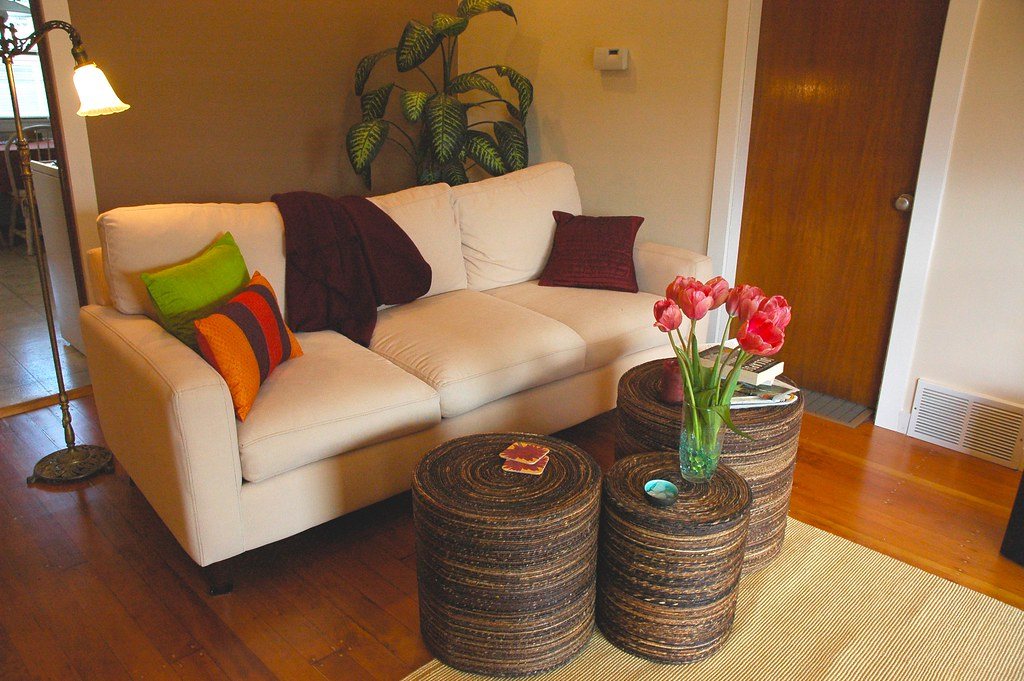
The third is a floating rug, which sits in front of the sofa with no furniture on it at all. It can work in a very small room, as in the photo at the top of this piece, where the jute rug sits under the side tables and in front of the sofa. But it has to be big enough to read as deliberate. As a rough guide, the rug should be at least as wide as the sofa, and ideally a few inches wider at each end.
The dining room: the 24-inch rule
Dining rooms have the one rule I would not bend. The rug needs to extend at least 24 inches past the edge of the table on every side, so that when someone pushes their chair back to stand up, all four chair legs stay on the rug. A chair that catches on the rug edge every evening gets old fast.
The math is easy. Take the table's length and width and add 48 inches to each (24 on both sides). A table that is 6 feet long and 3.5 feet wide needs a rug of at least 10 by 7.5 feet, which in practice means an 8 by 10. If you have leaves for the table, measure with them in if you use them often.
Round tables want round or square rugs. Use the same 24-inch rule from the table's edge all the way round.
The bedroom: think about where your feet land
In the bedroom, the goal is simple: when you get out of bed in the morning, your feet should land on something soft. The usual approach is to put a large rug under the bottom two-thirds of the bed, stopping short of the nightstands, with 18 to 24 inches showing on each side and at the foot.
For a queen bed, that generally means an 8 by 10. For a king, a 9 by 12 gives the same effect. A smaller 5 by 8 laid crosswise under the bottom half of the bed can work for a full or a twin, though I think it often looks a little short.
If a big rug is out of the budget, a pair of runners, one down each side of the bed, does the morning job just as well and costs less.
Halls and entryways
Runners in hallways should leave a strip of floor showing on both sides, usually about 4 to 6 inches, and stop short of the ends of the hall so they do not run into doors or the bottom step. Measure the door swing too. A thick runner under a door that clears the floor by a fraction of an inch will stop that door from opening, which is a surprisingly common annoyance.
At the front door, a rug should be at least as wide as the door itself. Anything narrower looks like a doormat that has wandered indoors.
Tape it out before you buy
Here is the step that saves the most money. Once you have a size in mind, mark its outline on the floor with painter's tape and live with it for a day or two. Walk around it. Pull the dining chairs out. Sit on the sofa and look at where the edges fall.
Taping is cheap and takes ten minutes, and it is much easier than returning a 9 by 12 rug. If you are stuck between two sizes, go with the bigger one; in my experience people almost never regret that choice. And whichever rug you end up with, put a rug pad underneath. It keeps the rug from sliding, makes it feel thicker, and helps protect the floor.
See more of us on GoogleAdd Home Knowledge as a preferred source and our stories can show up more often for you in Top Stories.