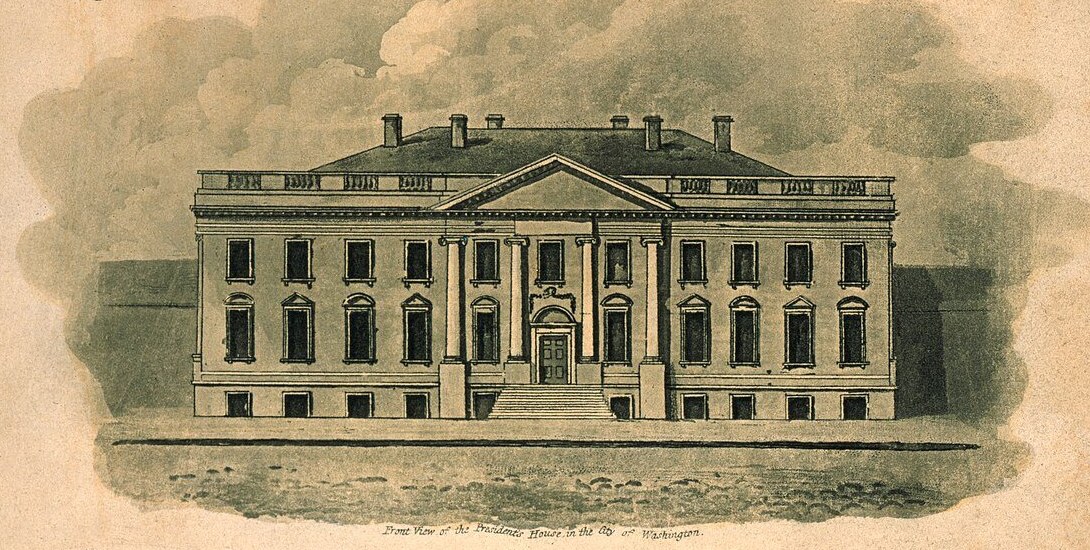
Print: unknown artist, published by James Cundee, London, 1807, public domain, via Wikimedia Commons
On November 2, 1800, the president of the United States sat down in a drafty new house and wrote to his wife. John Adams had moved in the day before, ahead of Abigail. The place was barely fit to live in. He told her so, and said he was glad she was coming anyway.
He closed the letter with a line that would long outlast the building's first coat of plaster: "I pray Heaven to bestow the best of Blessings on this House and on all that shall hereafter inhabit it. May none but honest and wise Men ever rule under this roof."
It is a lovely sentiment. It was also written in a house with bare walls in many rooms, one finished staircase out of three, and very little furniture. I have seen new owners complain about less after a kitchen remodel.
Eight years and still not done
The cornerstone had been laid on October 13, 1792. James Hoban, an Irish-born architect, had designed a neoclassical mansion in sandstone, on a scale that made sense for a capital city that didn't yet exist. The site was marshy ground near the river, which would matter later.
The federal government moved down from Philadelphia in 1800, and that set a hard deadline. Workers rushed to finish what they could before Adams returned from Quincy, Massachusetts, at the end of October. When he arrived, some of the furniture from the presidential house in Philadelphia had been brought in, and a portrait of George Washington was hanging on a wall. He had offers of private lodging and stayed in the house regardless, and I think that was probably a matter of principle as much as anything. A president's house ought to have a president in it.
What Abigail found
Abigail Adams reached Washington on Sunday, November 16, and on the 21st she wrote two letters that are the best inspection reports anyone ever filed on the place.
To her sister she wrote, "Not one room or chamber is finished of the whole." The house, she said, was "habitable by fires in every part, thirteen of which we are obliged to keep daily, or sleep in wet and damp places." Thirteen fires a day means a lot of firewood, and that was its own problem. As she told her daughter, in a good piece of 1800-style complaining, "wood is not to be had, because people cannot be found to cut and cart it!"
The bells for calling servants hadn't been put in either: "not one single one being hung through the whole house, and promises are all you can obtain." Anyone who has waited on a contractor will recognize that last clause. She estimated that keeping the place in order would take about thirty servants.
Then came the detail everyone remembers. The large unfinished reception room at the east end had no better use yet, so "the great unfinished audience-room I make a drying-room of, to hang up the clothes in." That room is now the East Room, where presidents hold state receptions. In 1800 it was full of damp linen, which may have been the most practical choice anyone made in the building that year.
To be fair to her, she saw what the house was going to be. "But this house is built for ages to come," she told her sister.
Damp walls and a five-month stay
Her complaints make sense to anyone who knows old construction. Fresh plaster holds a great deal of water and takes a long time to dry. Add a big masonry building on low, wet ground, an early-winter chill and fires as the only source of heat, and you get exactly the clammy air she described. People at the time worried about the "agues" that came with it, and she mentions keeping those fires going to hold them off.
As it happened, the Adamses didn't have to put up with it for long. Thomas Jefferson beat John Adams in the election that fall. Abigail left for Massachusetts in February 1801, after about three months in what she called "the great castle," and John left before Jefferson's inauguration on March 4. Jefferson moved in on March 19 and ordered many changes of his own, and the original building was finished only in 1802.
(So the first family to live in the White House never saw it completed. I doubt that's unusual for people who move into a new house on a deadline, though the consequences are usually smaller.)
The blessing on the mantel
More than a century later, Franklin Roosevelt had Adams's line carved into the mantel of the State Dining Room, where it remains. Whether the people under that roof have lived up to it is a question I'll leave to you.
What an owner can take from it
The physical lesson of November 1800 still applies to anyone moving into a new build or a big renovation, particularly at this time of year. New plaster, drywall compound and paint all release moisture for weeks, and a closed-up house in cold weather traps it. Run the heating steadily instead of in bursts, open windows for a short time each day, and keep an eye out for condensation.
Make a written list of what's unfinished before you move in, too, and get dates attached. "Promises are all you can obtain" has been a fair summary of the final stage of a building job for at least 226 years.
Public tours have traditionally been arranged through a member of Congress, though access has shifted with recent construction there, so check the White House website first. If you do get to the East Room, try to picture the washing.