On the north side of Lincoln's Inn Fields in London, there's a row of tall brick townhouses that look much like any others in the square, apart from one with a pale stone front that juts out a little. Behind it is one of the strangest homes in Britain.
It belonged to Sir John Soane, the architect who designed the Bank of England. Over about 30 years he bought three adjoining houses, knocked them through, rebuilt them more than once, and filled every surface with antiquities, casts, paintings and architectural fragments. Then he arranged for the law to keep it that way.
The house is now Sir John Soane's Museum. Entry is free, and walking through it still feels less like visiting a museum and more like letting yourself into the home of a very eccentric collector who has just stepped out.
Three houses, one obsession
Soane began with No. 12 Lincoln's Inn Fields in the 1790s, which he rebuilt as a family home. In the early 1800s he acquired No. 13 next door, and later No. 14. He rebuilt each one and ran them together behind the street fronts, so the house you walk through today is really a single winding interior spread over three plots.
He used the houses as a home, an office for his architectural practice and a teaching collection for students. Over the years the "teaching collection" part took over, which anyone who has ever started keeping "just a few" of something will understand.
Light from places you don't expect
What makes the house remarkable to an architect (and to me) is how Soane handled light and space in a narrow London plot. He couldn't spread out, so he worked upward and inward. Skylights, lantern lights and colored glass bring daylight down into rooms that should by rights be dark.
The breakfast room is the best known example. A shallow dome floats over the room, held on slender arches, with daylight sneaking in from openings around the edges. Small convex mirrors are set into the ceiling and walls, so the room seems bigger and more complicated than it is. Soane used mirrors all through the house in a similar way, to stretch views and bounce light.
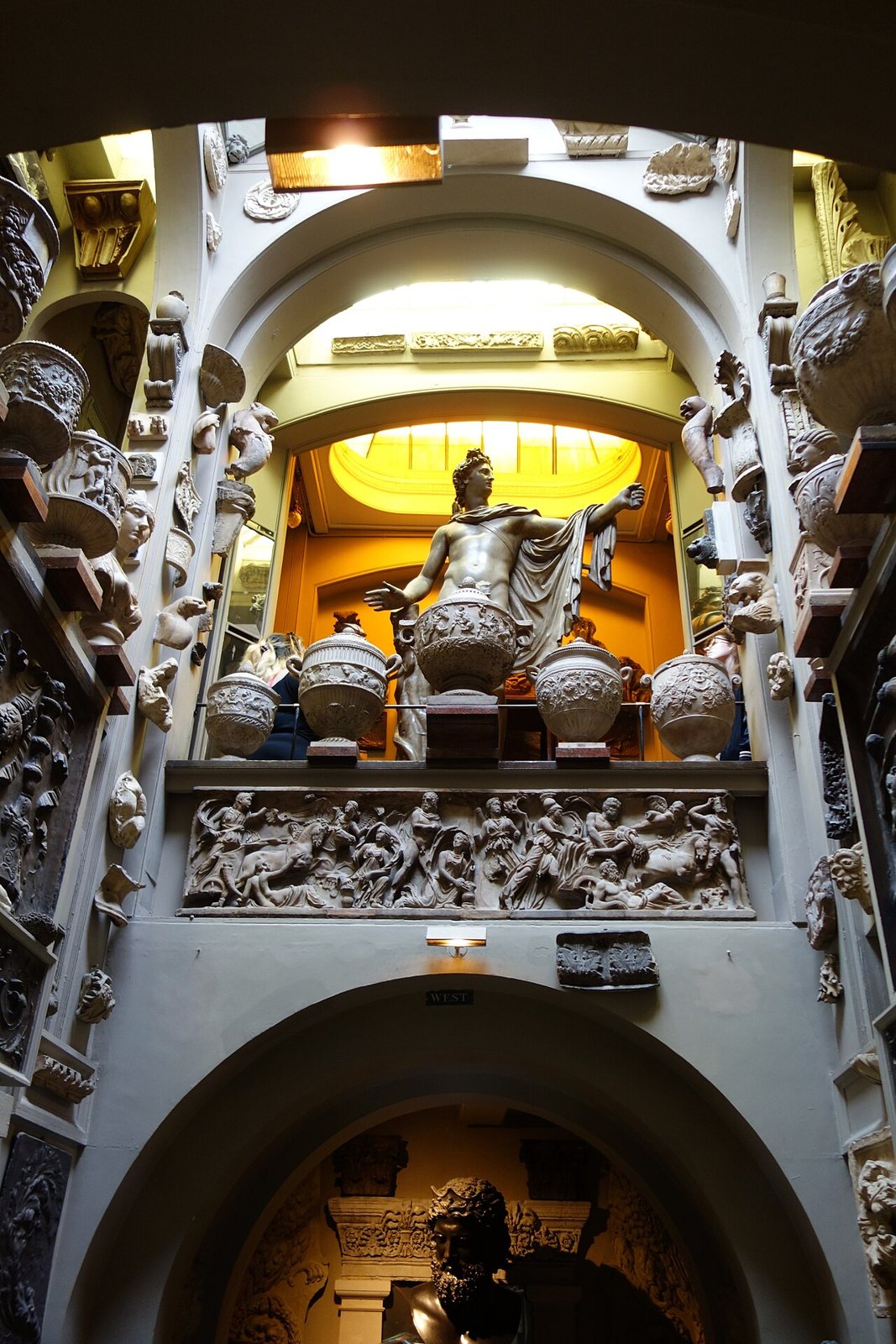
The central dome area, in the photo at the top of this page, is the other showpiece. It's a tall well of space, lit from above, with classical casts, urns and carved fragments stacked on every ledge from floor to ceiling. Looking down into it from the upper level is a little dizzying.
A sarcophagus in the basement
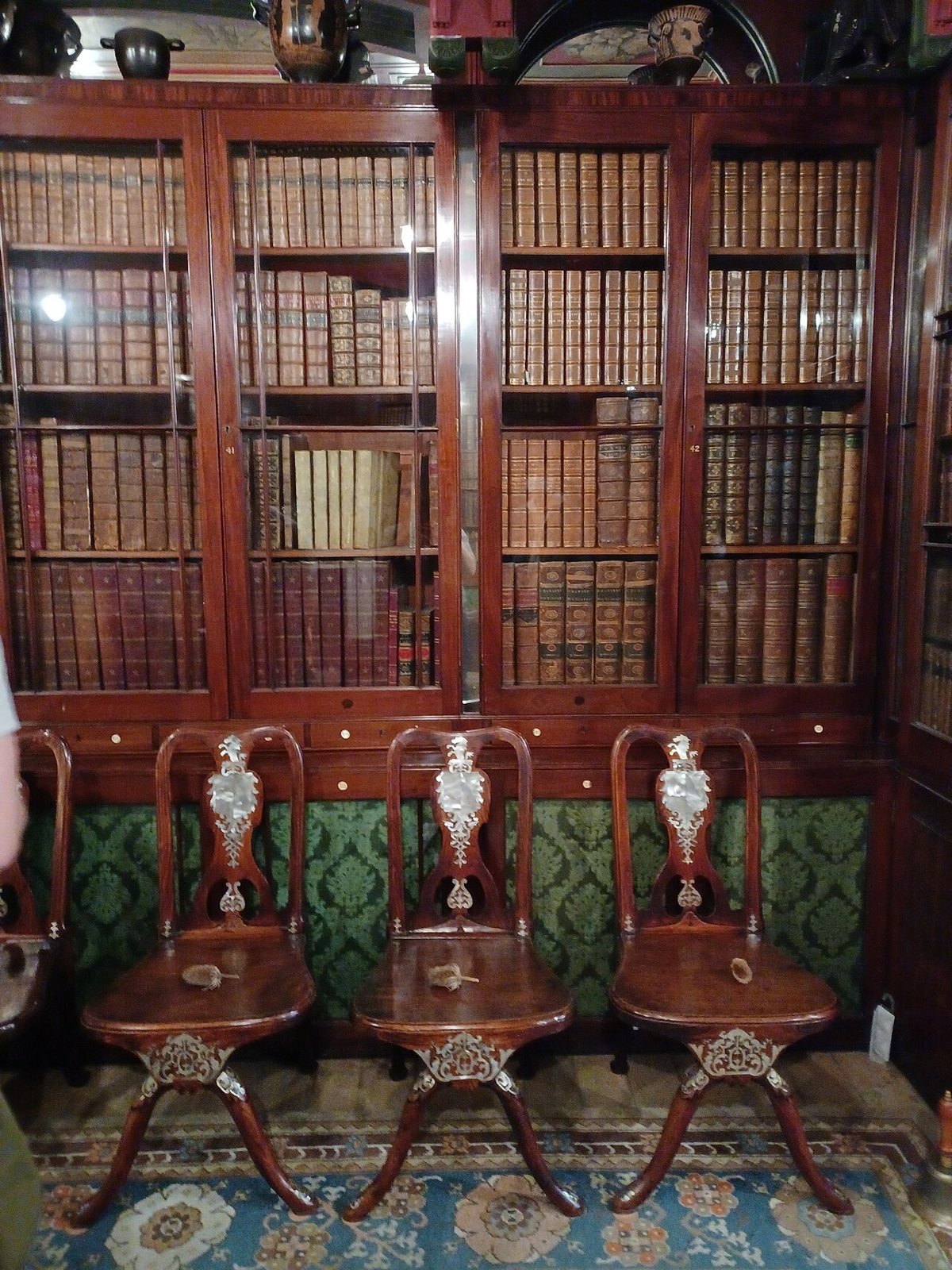
Bookcases and carved chairs in the library at Sir John Soane's Museum. Photo: Simon Burchell, CC BY-SA 4.0, via Wikimedia Commons
The most famous object in the house is the alabaster sarcophagus of the Egyptian pharaoh Seti I, which Soane bought in the 1820s after the British Museum passed on it. Getting it into the basement reportedly required taking out part of a wall. To celebrate, he threw a series of evening parties where guests viewed it by lamplight, which is the kind of housewarming I'd quite like to have been invited to.
Upstairs, the Picture Room solves a storage problem in a way I've never seen copied well. The walls are hinged panels that fold out like the pages of a book, so a small room can hang far more paintings than its size suggests. Among them is William Hogarth's series A Rake's Progress, and the four paintings of his series An Election.
Elsewhere you'll find the Monk's Parlour, a gloomy, gothic room Soane built around an imaginary monk he invented as a kind of joke, and a model room with architectural models, including cork models of ancient buildings.
Why nothing has moved
Soane's relationship with his sons was difficult, and he did not want his house and collection broken up or sold after his death. In 1833 he got a private Act of Parliament passed that settled the house and its contents on the nation, on condition that they be kept as nearly as possible as he left them, and open to visitors.
He died in 1837, and the trustees have kept to the spirit of that ever since. Over the past couple of decades, the museum has carried out restoration work to bring back rooms and arrangements that had been altered over the years, using Soane's own records and drawings to put things back where he had them.
Visiting if you're in London
The museum sits at 13 Lincoln's Inn Fields, near Holborn station. Admission is free, but it's popular and the rooms are small, so expect a short queue on weekends. Bags usually have to be checked, because you really don't want a backpack swinging near those shelves.
If you are a homeowner, the house is worth a visit just for the lessons in light. Soane's mirrors, borrowed light and top-lit stairwells are tricks that work just as well in a narrow terraced house or a dim hallway today. Check the museum's own website before you go for current opening days and any candlelit evening events, which sell out quickly.
See more of us on GoogleAdd Home Knowledge as a preferred source and our stories can show up more often for you in Top Stories.