Photo: William F. Winter, Jr., public domain, via Wikimedia Commons
Walk into almost any kitchen showroom this year and you will see the same cabinet door again and again: a flat centre panel, a plain square frame around it, no carving, no molding. Sales staff call it a Shaker door. Most buyers never ask why.
The name comes from a small religious community that built some of the most quietly influential furniture in American history. The Shakers made chairs, boxes, cupboards and whole buildings in the late 1700s and 1800s, and a lot of what they made would look perfectly at home in a new apartment today. I would argue it looks better than a lot of what is actually in new apartments (I admit I am biased toward anything with a peg rail).
Who the Shakers were
The Shakers were a Protestant sect, formally the United Society of Believers in Christ's Second Appearing. They got their nickname from the shaking and dancing in their worship. The group began in England, and a small band led by Ann Lee, known to her followers as Mother Ann, sailed to America in 1774.
They lived in self-contained villages in New York, New England, Ohio and Kentucky, holding property in common and practicing celibacy. That last point explains a great deal about their history: with no children born into the faith, they depended on converts and adopted orphans, and their numbers shrank steadily after the mid 1800s. A single community, at Sabbathday Lake in Maine, still lives as Shakers today, with only a handful of members.
What they left behind is mostly the work of their hands. Furniture, tools, buildings and songs, including "Simple Gifts," the 1848 tune that Aaron Copland later folded into Appalachian Spring.
Built for use, then made beautiful
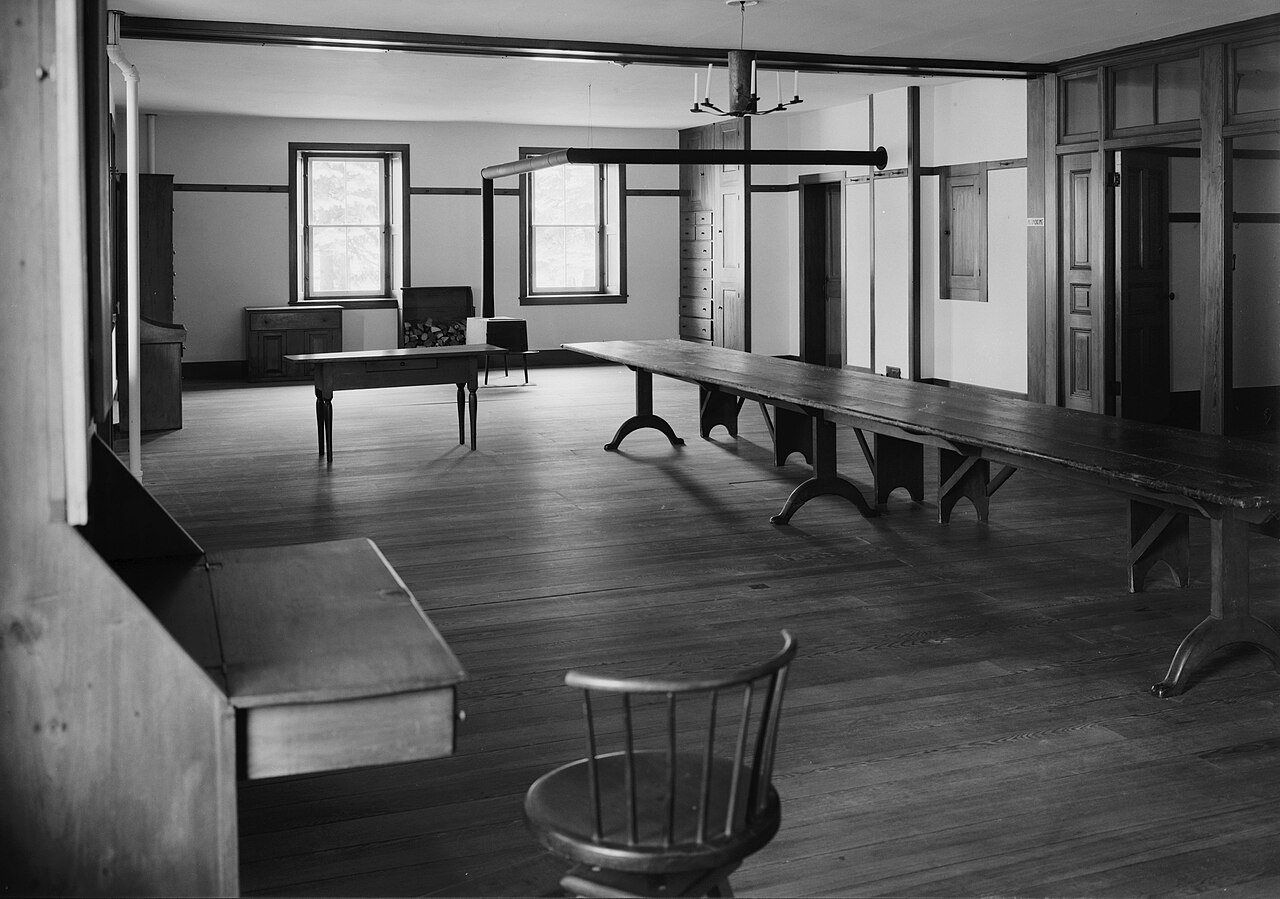
A large Shaker room with long trestle tables, plain benches, a swivel stool and tall built-in cupboards. Photo: Jack E. Boucher, public domain, via Wikimedia Commons
Shaker belief treated work as a form of worship. Doing a job carefully was a moral matter, and that attitude shows in the joinery. Their furniture is light, plain and very well made, with almost no applied decoration. There is a saying often attributed to them, along the lines of: don't make something unless it is both necessary and useful, but if it is both, don't hesitate to make it beautiful. Its original source is hard to pin down, but it describes the furniture well.
The beauty is in proportion. Chair legs taper. Drawer fronts step down in size from bottom to top. Wood was usually stained or painted in a few plain colours, and the finish was meant to protect it, not to show off.
The peg rail and the chair on the wall
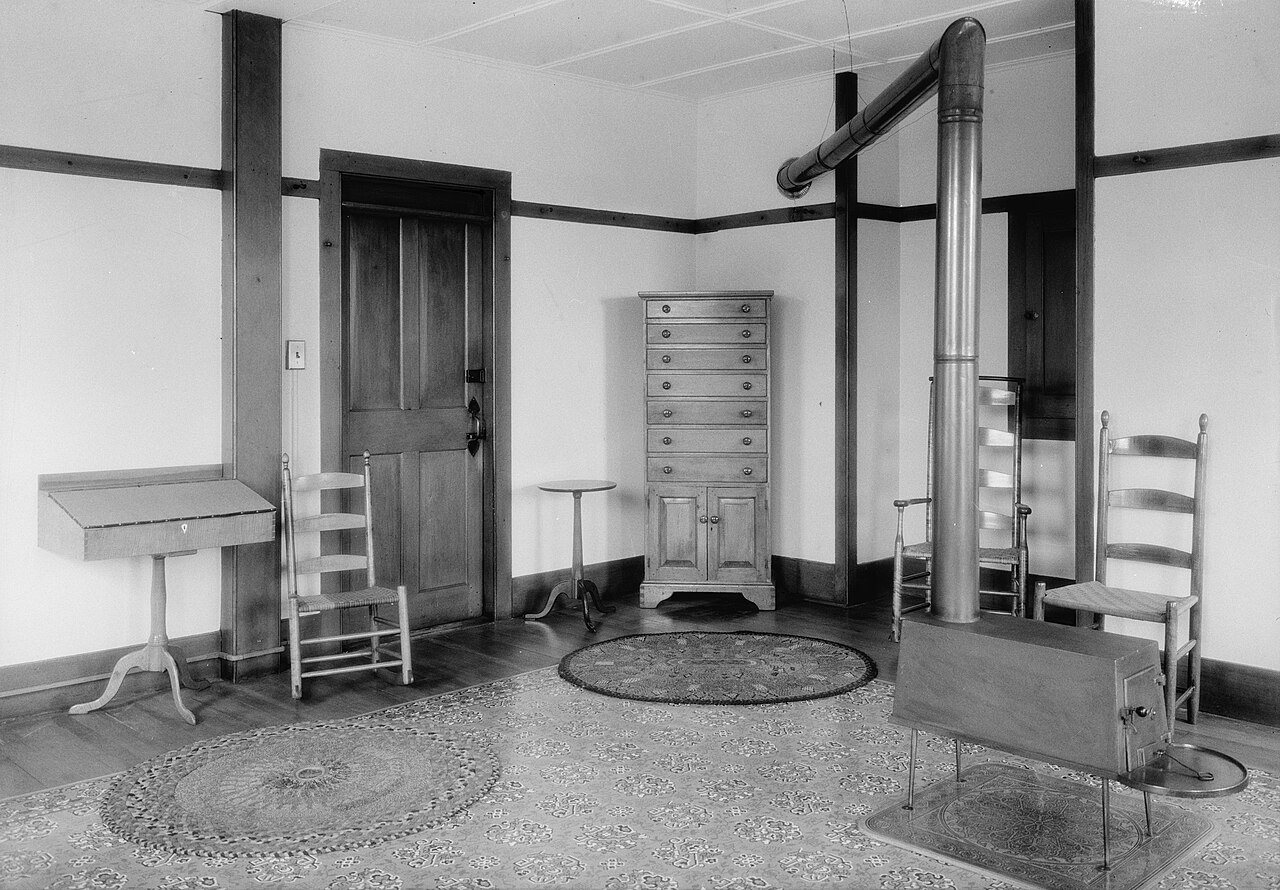
If you remember one Shaker idea, make it the peg rail. A strip of wood ran around the walls of a room at about head height, fitted with turned wooden pegs every foot or so. Coats, hats, baskets, candle sconces, mirrors and clocks hung from it. So did the chairs.
Shaker ladder-back chairs were light enough to lift with one hand, and at cleaning time they were turned upside down and hung on the rail, leaving the floor completely clear for sweeping. It is such a sensible idea that it is a little embarrassing modern homes abandoned it.
The chairs themselves became a business. The Shaker community at Mount Lebanon, New York, ran a chair factory in the second half of the 1800s and sold its chairs to the public through catalogues, in a range of numbered sizes. Those are the chairs most collectors mean when they talk about Shaker chairs today.
Built-ins and a lot of drawers
Shaker dwellings often had storage built straight into the walls: tall banks of drawers and cupboards running floor to ceiling, flush with the room. In a house shared by dozens of people, everything needed a place, and a built-in cupboard could not be knocked over or left in a hallway. The room in the photo above shows the idea, with tall cupboards set into the wall behind the tables.
Their oval wooden boxes, with the overlapping joints known as swallowtails or fingers, solved the smaller storage problems. They were stackable, and the fingers let the thin wood swell and shrink with the seasons without splitting. People still make and collect them.
How Shaker style reached the modern kitchen
The plain lines of Shaker furniture appealed to 20th century designers who were trying to strip decoration out of everyday objects. Danish furniture makers in particular are often said to have studied Shaker pieces, and you can see the family resemblance in some mid-century Scandinavian chairs. Whether the influence was direct in every case is debated, but the shared taste for honest wood and simple forms is hard to miss.
The kitchen cabinet door is the most common descendant. Its recessed flat panel is easy to make, easy to clean and does not date quickly, which is exactly why cabinet makers keep offering it.
Borrowing the idea at home
You don't need antiques to live a little more like a Shaker. A peg rail in a hallway or mudroom costs very little and does more work than most hooks. Hang it high enough that long coats clear the floor, and screw it into studs, because people will hang heavy bags on it.
In a bedroom or kitchen, think about built-in storage before freestanding furniture, and favour plain doors and drawer fronts that will not look tired in ten years. Choose fewer, lighter chairs. And if you have floors to clean this winter, try lifting the chairs off them before you start. It takes a minute and makes the job noticeably quicker.
See more of us on GoogleAdd Home Knowledge as a preferred source and our stories can show up more often for you in Top Stories.