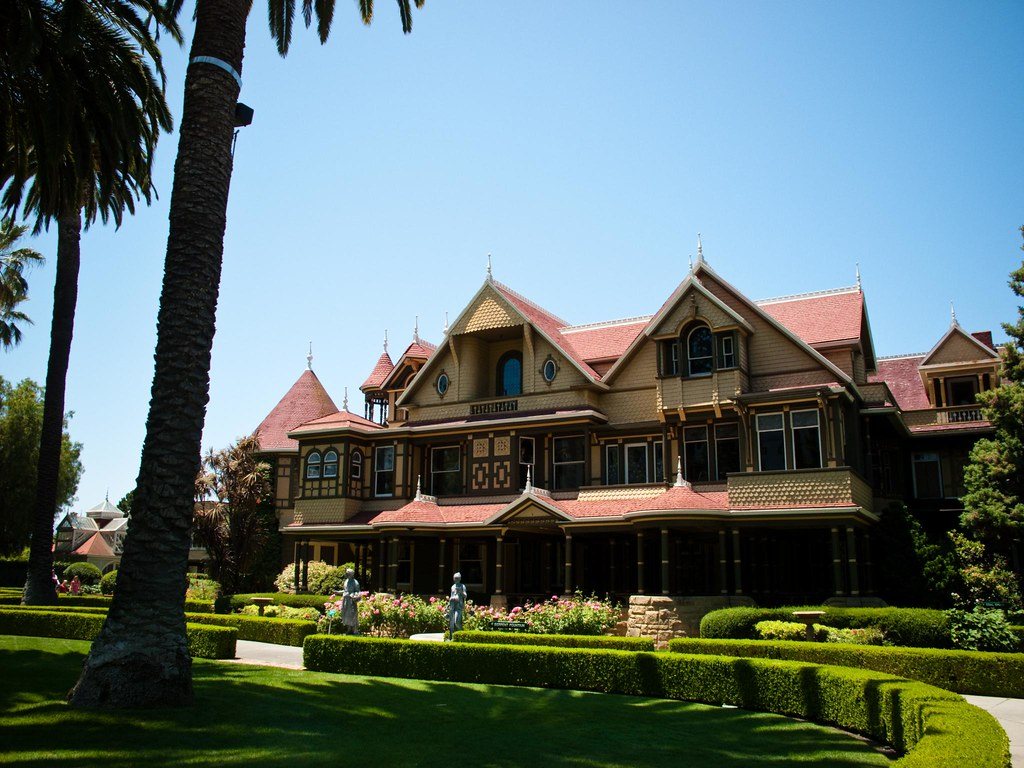
In San Jose, California, a few minutes from a busy freeway and a cinema complex, there is a sprawling Queen Anne mansion where a staircase climbs to the ceiling and stops, and a door on an upper floor opens onto a drop to the garden below. Every October the crowds get bigger.
The Winchester Mystery House is one of the most famous houses in America, and most of what people know about it comes from a single story. Sarah Winchester, heir to a rifle fortune, was told by a medium that the spirits of everyone killed by Winchester guns would haunt her unless she kept building, so she kept the hammers going day and night for 38 years.
It is a great story. Historians who have gone through her letters think most of it isn't true, and the version they have pieced together is, to my mind, more interesting.
Who Sarah Winchester actually was
Sarah Lockwood Pardee married William Wirt Winchester, son of the founder of the Winchester Repeating Arms Company. Their only child, a daughter, died in infancy. William died in 1881. Sarah inherited a large share of the company and with it one of the larger fortunes of the age.
In 1886 she moved west and bought an unfinished farmhouse in the Santa Clara Valley, then open farmland outside San Jose. She started adding to it. She kept adding to it, on and off, until she died there in 1922.
The most thorough account of her life is Mary Jo Ignoffo's biography, Captive of the Labyrinth. Ignoffo's Sarah is a capable, very private woman who managed her money carefully, ran a working ranch, and used architecture as a hobby on an enormous scale. It is a long way from the haunted widow in the brochures.
The building never really stopped, except when it did
The "38 years, around the clock" claim is the first thing Ignoffo takes apart. Sarah's letters show her sending her workers away for months at a time. Building on the house was continuous in the sense that a rich person's pet project is continuous: it went on for decades, with long pauses whenever she lost interest or went elsewhere.
What is true is the scale. By the time she died, the house had about 160 rooms, according to the figure most often cited, and it had been bigger before 1906.
What the 1906 earthquake did to the house
The great San Francisco earthquake of April 1906 hit San Jose hard too. The Winchester house had grown to seven stories by then, with a tower on top. The upper floors came down and were never rebuilt. Today the house is four stories at its tallest.
This matters for the ghost story more than anything else. Many of the house's famous oddities, the stairs that end at a ceiling and the doors that open onto a wall or a sheer drop, are best explained as leftovers from the earthquake and the patching afterwards. A room that once led somewhere stopped leading anywhere when the floor above it fell in. Sarah never fully repaired the damage and spent much of her later life at other homes she owned.
Walk through it with that in mind and the house reads differently. You stop seeing traps for spirits and start seeing a damaged building that its owner chose to close off and leave alone.
Seances, the number 13 and other later additions
The legends kept growing after Sarah died. The "seance room" is a good example. According to Ignoffo, there is no evidence Sarah held seances at home, and the first mention of a seance room turns up in a promotional article in 1928, six years after her death.
The famous obsession with the number 13 has a similar history. Ignoffo found that many of the 13s pointed out to visitors (thirteen hooks, thirteen panes and so on) were added after Sarah's death, some of them only in recent decades.
The house was opened to paying visitors in 1923, the year after Sarah died, and it has been marketed on the mystery angle ever since. I don't hold that against anyone. A house that needs ticket sales to stay standing will tell the story that sells tickets.
The woman behind the legend
The sadder part is what the legend crowded out. People who knew Sarah, including former workers, neighbors and two young men who grew up on the Winchester ranch, described a generous employer who kept staff on for decades, remembered them in her will and helped some buy homes. Their accounts got far less attention than the ghost story.
There is also no good evidence she felt guilty about the family business. In her lifetime the Winchester company was seen as an American success story, and she spent its money without apparent unease.
None of this makes her ordinary. She spent decades and a fortune on a house that never quite became a finished thing, and that is an eccentric way to live by anyone's standard. It just isn't a haunted one.
Visiting the house this season
The house is privately owned and run as a visitor attraction, with guided tours of the interior and special themed tours around Halloween. Check the official site for current tour times and booking before you go, because autumn weekends sell out.
If you go, try to see it twice in your head. First as the haunted maze the tour wants you to see. Then as a real house, built and rebuilt by a widow with a lot of money and very few people she trusted, and shaken half to pieces in 1906. I found the second version stuck with me a lot longer on the drive home.